BESIDE ME
2026
Bob Mizer often dressed his models with purpose: a sailor’s cap, a centurion’s helmet, a Greco-Roman spear. Mizer’s props did several things at once: they set a scene, built a fantasy, and invoked an archetype that carried particular meaning for men who had limited representations of their own desire. The props also provided legal cover—an artistic or narrative context that meant the photographs could be legally mailed. The object was never decoration. It made desire visible without naming it.
The model in the original photograph wore a sailor’s cap. It is no longer visible.
In its place: a crown of leaves and flowers drawn from the visual vocabulary of Frida Kahlo—specifically her painting Diego on My Mind. Flowers have long served as coded language for love that could not be openly declared. Sappho wrote of the lover (translated by Mary Barnard):
…the many [crowns]
of violets and roses
you wove, and put on,
there beside me…
Where the sailor’s cap once coded desire as fantasy, the flowers declare a message of love that the world once required to be hidden.
The model is Jim Grant. The photograph was taken by Bob Mizer for the Athletic Model Guild in 1949.
$795 CAD
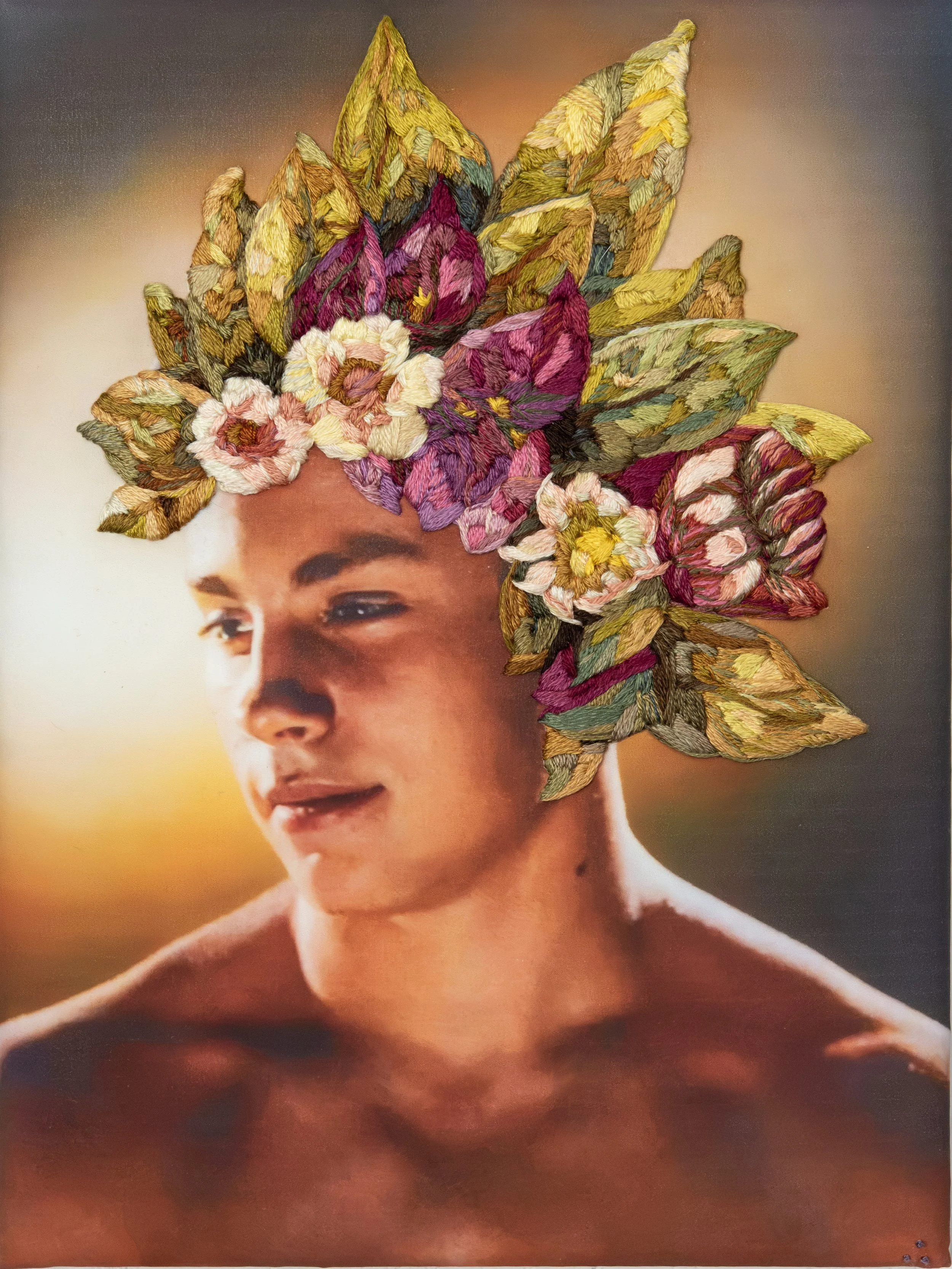
Beside Me
Bob Mizer often dressed his models with purpose: a sailor’s cap, a centurion’s helmet, a Greco-Roman spear. Mizer’s props did several things at once: they set a scene, built a fantasy, and invoked an archetype that carried particular meaning for men who had limited representations of their own desire. The props also provided legal cover—an artistic or narrative context that meant the photographs could be legally mailed. The object was never decoration. It made desire visible without naming it.
The model in the original photograph wore a sailor’s cap. It is no longer visible.
In its place: a crown of leaves and flowers drawn from the visual vocabulary of Frida Kahlo—specifically her painting Diego on My Mind. Flowers have long served as coded language for love that could not be openly declared. Sappho wrote of the lover (translated by Mary Barnard):
…the many [crowns]
of violets and roses
you wove, and put on,
there beside me…
Where the sailor’s cap once coded desire as fantasy, the flowers declare a message of love that the world once required to be hidden.
The model is Jim Grant. The photograph was taken by Bob Mizer for the Athletic Model Guild in 1949.
-
Beside Me is 6 x 8 inches (15.24 × 20.32 cm). The vintage photograph is transferred to a tight weave cotton and embroidered with cotton thread and Japanese gold thread. The image is mounted on art board and floated on a mat board and behind glass.
The black wood frame is 11" x 14" (approximately 30 cm x 36 cm). The piece is ready to hang with D-rings and wire on the back. A hook and nail is included.
-
Visa, MasterCard, American Express, Apple Pay, Google Pay, Klarna, Afterpay, Link, and other options are available.
-
Works are carefully packaged with two boxes and thick foam.
Pieces are shipped via courier with tracking. A flat rate price will be applied after the destination country is entered into the address form.
All pieces ship from Vancouver, Canada. Delivery times vary by destination. -
Shipping costs take into account taxes/tariffs/duties as much as possible.
The fees are determined by your country's regulations and are subject to change. Additional import fees, not already included in the flat rate shipping cost, may be levied by the local authority. Any additional charge is the responsibility of the purchaser.
-
Each piece is framed and ready to hang. The length of the hanging wire can easily be adjusted. A hook and nail is included.
The glass and frame can be cleaned with a cloth dampened with clean, soapy water or glass cleaner solution.
Display your artwork away from direct sunlight and heat sources.
-
A Certificate of Authenticity is provided with each piece.
The vintage images are sourced from online archives, collectors, and dealers. I credit photographers, studios, and models whenever the record allows.
Queer art has a long history of appropriation, largely because overt self-expression was not possible for gay people. Appropriation allowed artists to code messages in their work and, in many cases, pay tribute to those who came before them — artists who were unable to fully express themselves openly.
My work continues this tradition. It is grounded in the work of pioneer photographers and models; to these images I add new expressions of meaning that comment on the history of queer culture and people.
The source photographs are black and white. I apply a digital colourization before the image is transferred to cotton — not to modernize it, but because the contrast of black and white against coloured embroidery thread is too stark. The colourization is deliberately unrefined; I want the image to retain its age. Beyond this, I make no alterations to the photograph.
-
All sales are final. In the unlikely event your piece arrives damaged, please photograph the packaging and artwork immediately upon receipt and contact me within 48 hours. I will work with you to find a resolution.
-
Every original is one of a kind. I will never create a second embroidered piece that replicates an original artwork.
When you purchase an original piece, you're acquiring the physical artwork itself. I retain copyright and all reproduction rights to the image.
I reserve the right to produce limited-edition reproductions of an image — such as printed enlargements — before or after an original sells. These are prints, not new embroidered originals, and are always produced in limited numbers.
Frequently Asked Questions